

Table of Contents
- What Is the 3-5-7 Rule in Decorating?
- How to Apply the 3-5-7 Rule to Living Rooms and Shelves
- How to Style a Coffee Table Like a Pro Using the 3-5-7 Rule
- Using the 3-5-7 Rule for Gallery Walls and Mantels
- The '7' Threshold Challenge: When More Becomes Clutter
- Color and Texture Integration for a Curated Look
- Interior Design Styling Tips for Beginners on a Budget
- Conclusion
- Frequently Asked Questions
Last Updated: September 27, 2026
What Is the 3-5-7 Rule in Decorating?
What is the 3-5-7 rule in decorating? It is a styling method that groups objects in odd numbers, usually three, five, or seven items, to create visual balance on shelves, tables, and mantels. This guide from The Finishing Touch Decor, LLC breaks down how the rule works and when to bend it.
Odd groupings feel natural because the eye never settles into a stiff, mirrored pattern. A set of three vases reads as relaxed. A set of four often reads as a grid.
Here's the part most guides skip: the rule is not really about the number. It's about visual weight.
Where the Rule Comes From
No one invented the 3-5-7 rule in a single moment. It grew out of centuries of art and design practice, where odd numbers have long been used to create asymmetric balance.
The idea shows up in painting, photography, and floral arranging. A composition with three points of interest keeps the eye moving. A composition with two points often feels static, like a staring contest.
Interior designers adopted the principle because it solves a common problem: how do you arrange a group of objects so it looks intentional, not accidental?
Why Odd Numbers Work: The Rule of Odds in Interior Design
The rule of odds in interior design says that objects grouped in odd numbers are more visually pleasing than even-numbered groups. Three, five, or seven items create a focal point the eye can rest on.
Here's why it works. In an even group, the eye splits its attention between pairs. Nothing leads. In an odd group, one item becomes the anchor, and the rest support it.
That anchor is your focal point. It might be the tallest vase, a bold lamp, or a piece of wall art. The other objects play backup.
How to Apply the 3-5-7 Rule to Living Rooms and Shelves
Start with your largest piece, then build outward in odd numbers. A shelf with three objects needs one clear anchor and two smaller companions that differ in height. That's the version every guide gives you. The part that actually makes it work is how you distribute visual weight across the surface.
Visual weight is the perceived heaviness of an object. It comes from four things: size, color contrast, texture, and height. A small matte-black object can outweigh a large pale one because dark colors read heavier than light ones. A glossy ceramic reads heavier than raw wood. A tall thin vase can balance a short wide bowl because height pulls the eye upward.
Here's a simple sequence to follow:
- Place your tallest or boldest piece slightly off-center, roughly one-third from one edge, not dead center
- Add a medium object to one side, offset so it doesn't line up with the anchor's top or bottom
- Add a small object to the other side to counterbalance the visual weight
- Step back and check the silhouette, the outline the group makes against the wall
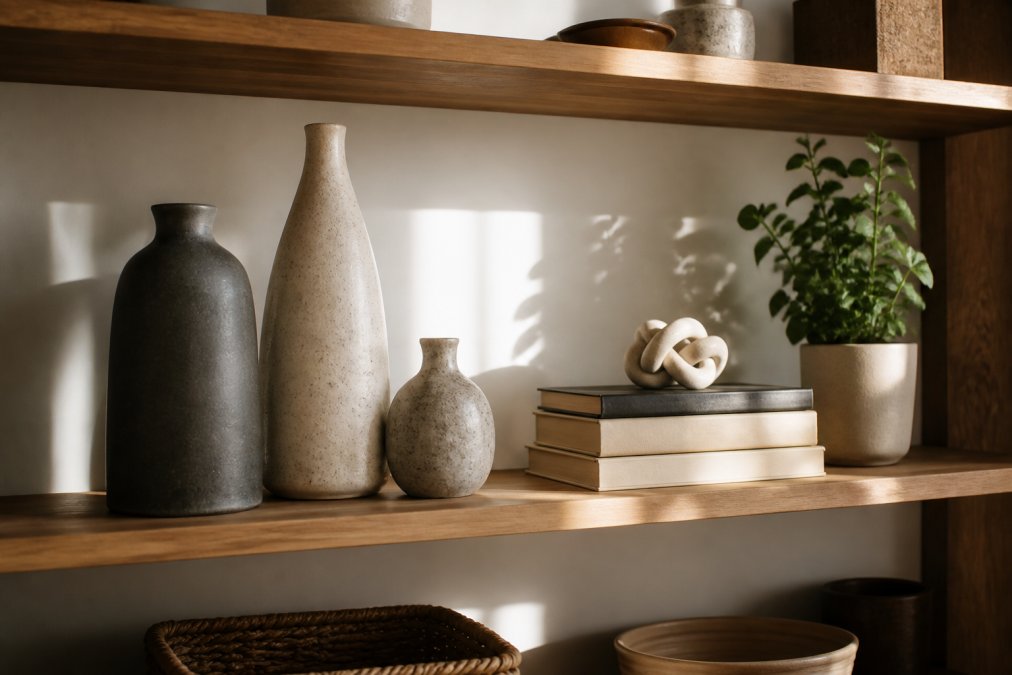
The same logic scales up. For a larger surface, move to five or seven objects. Just keep the anchor clear.
Scale and Proportion: The Nuance Most Guides Skip
Most guides tell you to group in threes and stop there. That advice fails when your objects are wildly different sizes.
Proportion matters more than count. A tiny figurine next to a giant floor vase will look lost, no matter how you arrange the group. Match your objects to the surface they sit on. A useful rule of thumb: your anchor piece should be roughly one-third to one-half the height of the space it occupies. On a 30-inch shelf, that means an anchor around 10 to 15 inches tall. On a 60-inch console, an anchor in the 20 to 30 inch range.
A common mistake is buying a set of three identical vases and calling it done.
How to Style a Coffee Table Like a Pro Using the 3-5-7 Rule
To style a coffee table like a pro, build three layers: a base, a middle, and a top. A stack of books forms the base, a bowl or tray sits in the middle, and a tall object adds height.
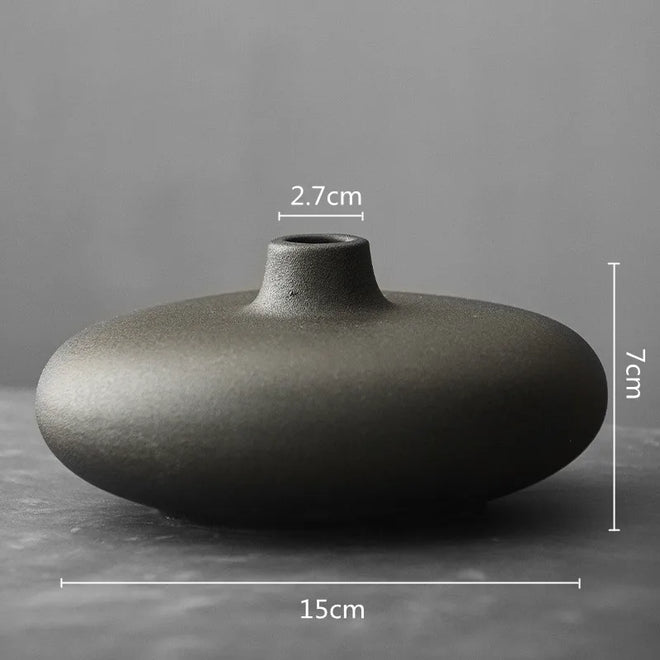
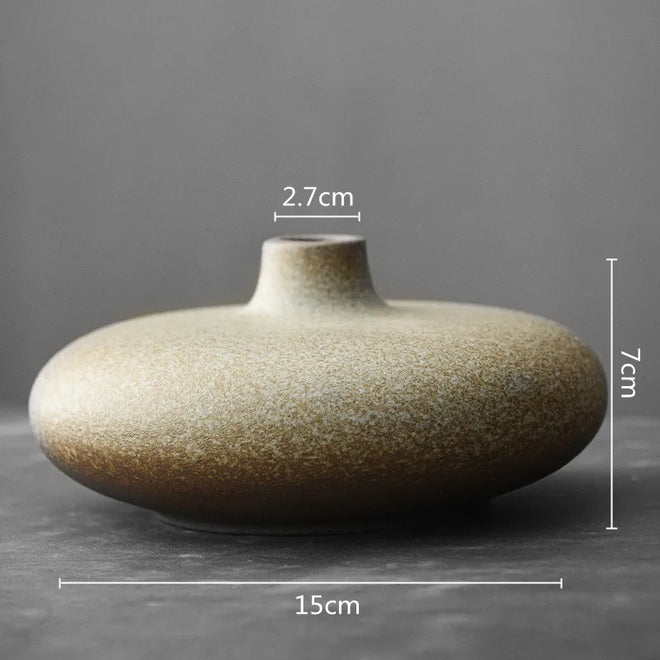
White Set of 3 Clay Speckled Handled →
Try this three-piece formula:
- A stack of two or three books
- A small tray or bowl on top
- One tall element, like a vase or candle holder
Sizing the Group to the Table
This is where most coffee table advice falls apart. The right count depends on the table's footprint, not a fixed number.
A quick sizing guide:
| Table size | Object count | Anchor size | Layout shape |
|---|---|---|---|
| Small round (under 36 in.) | 3 | 10-12 in. | Triangle |
| Medium rectangular (36-48 in.) | 3-5 | 12-16 in. | Diagonal line |
| Large rectangular (over 48 in.) | 5 | 16-20 in. | Two clusters |
| Oversized (over 60 in.) | 5-7 | 20 in.+ | Two or three clusters |
Sightlines and Function
The coffee table sits in the middle of the room, so it's the one surface where the rule has to share space with real life. Before you finalize a group, sit on the sofa and look across the table. If the tallest object blocks the TV, a fireplace, or a view, move it to the side or swap it for something shorter.
Using the 3-5-7 Rule for Gallery Walls and Mantels
Gallery walls and mantels follow the same odd-number logic, but the spacing changes. On a wall, the "objects" are frames. On a mantel, they're a mix of art, candles, and small decor.
Keep these rules in mind:
- Vary height so the eye travels up and down
- Leave breathing room between frames
- Balance heavy items with lighter ones on the opposite side
The '7' Threshold Challenge: When More Becomes Clutter
Seven is where the rule starts to strain. Past seven objects, most surfaces tip from curated into cluttered.
Ask yourself three questions:
- Does this piece add height, texture, or color?
- Does it support the focal point?
- Would the group look better without it?
Color and Texture Integration for a Curated Look
Color and texture carry as much weight as shape. A group of three objects in the same color but different textures reads as rich. The same group in three clashing colors reads as chaotic.
Interior Design Styling Tips for Beginners on a Budget
Interior design styling tips for beginners don't require a big budget. The rule works with what you already own.
A few budget-friendly moves:
- Group three small objects instead of buying one large statement piece
- Use books you already own as risers and layers
- Mix thrifted finds with new pieces for a collected look
- Rotate decor seasonally instead of buying more
| Surface | Object Count | Anchor Piece | Watch Out For |
|---|---|---|---|
| Small shelf | 3 | Tallest vase | Overcrowding |
| Coffee table | 3-5 | Book stack or bowl | Blocking sightlines |
| Mantel | 5-7 | Large art or mirror | Too much symmetry |
| Gallery wall | 3-7 frames | Largest frame | Even spacing |
| Console table | 5 | Lamp or sculpture | Flat height line |
Conclusion
The hardest part of decorating isn't finding objects. It's knowing when to stop adding them.
Frequently Asked Questions
What is the difference between the 3-5-7 rule and the rule of odds?
The rule of odds is the broader principle that odd-numbered groupings of objects look more natural and visually interesting than even-numbered ones. The 3-5-7 rule is a specific application of that principle, giving you three set group sizes to work with depending on the surface. Think of the rule of odds as the theory and the 3-5-7 rule as the practical formula for decorating.
Can the 3-5-7 rule be used for wall art arrangements?
Yes. A gallery wall with three large prints, five medium frames, or seven small pieces follows the same logic. Odd numbers create asymmetric balance, which feels more dynamic than a perfectly symmetrical grid. For a seven-piece gallery wall, anchor the arrangement with one larger piece and build outward, keeping consistent spacing between frames so the grouping reads as one unit.
Is the 3-5-7 rule effective for small living spaces?
It works especially well in small rooms because it prevents over-decorating. A coffee table in a small apartment might only handle a group of three: a small vase, a candle, and a book. Sticking to the lower end of the scale keeps negative space intact, which makes a compact room feel intentional rather than crowded. Scale each grouping to the surface, not to the room.
How does the 3-5-7 rule help prevent visual clutter?
The rule gives you a stopping point. Without a target number, it is easy to keep adding objects until a shelf or table feels heavy. By committing to three, five, or seven items, you force yourself to edit. That editing process creates visual rhythm and preserves negative space, two elements that separate a curated look from a cluttered one. Start with the smallest number that fills the space and add only if it feels empty.