

Table of Contents
- How to Mix Interior Design Styles Without a Designer
- Mixing Textures in Home Decor: The Fastest Way to Add Depth
- A Cohesive Room Design Guide for Real Budgets
- Using Scale, Proportion, and Focal Points to Ground a Mix-and-Match Room
- Room-by-Room Mix-and-Match Home Furnishings Ideas
- Common Mistakes That Make a Mixed Room Look Cluttered
- Frequently Asked Questions
Last Updated: September 18, 2026
How to Mix Interior Design Styles Without a Designer
You don't need a designer to express personal style through mix-and-match design options for home furnishings. You need a plan, a neutral base, and the confidence to break a few rules. Below, we'll show you exactly how to blend styles without a single design degree.
Start with the room you actually live in. Most people try to fix everything at once. That's the first mistake.
Find Your Style in Your Habits, Not Your Pinterest Board
Most guides tell you to pick a style from a list. That approach fails because it asks you to choose an aesthetic before you understand your own patterns. A more reliable method is to read your style off your daily life, the way you actually use a room tells you what it should look like.
Ask yourself four questions about the room you are working on:
- Where do you actually sit? If you always end up on the floor or the corner of the sofa, you don't need a formal seating arrangement. You need a deep chair, a floor cushion, or a low table.
- What do you touch every day? The mug you reach for, the blanket you pull over your legs, the tray you set your keys on. These objects are your real style signals. Their materials, ceramic, wool, wood, metal, are the palette your room should repeat.
- What do you refuse to give up? A inherited chair, a loud rug, a piece of art. These are your anchors. Build the room around them instead of hiding them.
- How do you want the room to feel at 8 p.m.? Calm, energized, cozy, or social. Feeling is a design brief. "Cozy" points to warm textures and low light. "Social" points to flexible seating and clear sightlines.
A common pattern is that people who describe their style as "minimalist" actually mean "low-maintenance," and people who describe it as "eclectic" actually mean "collected over time." Those are different goals, and they lead to different furniture choices. Naming the real goal is the first step.
Pick Two Styles, Not Five
Once you know how you live, the style choice gets easier. Pick two styles, not five. One leads, one supports. That's it.
- Dominant style: about 70% of the room
- Supporting style: about 30%
- Neutrals: the glue that holds both together
For example, pair Coastal as your lead with Bohemian accents.
The 80/20 Rule of Furniture Mixing
A useful way to keep a mixed room from tipping into chaos is the 80/20 rule: roughly 80% of the room should feel like one coherent idea, and roughly 20% should be the surprise. The 20% is where personality lives, the vintage lamp, the bold art, the inherited chair. The 80% is what makes the 20% read as a choice instead of an accident.
Mixing Textures in Home Decor: The Fastest Way to Add Depth
Texture is the fastest way to make a mixed room feel intentional. A room with five different colors but only one fabric looks flat. A room with three colors and six textures looks designed. Pattern is texture's partner, and it is where most people freeze.
Layer Smooth, Woven, and Fuzzy Fabrics
The rule is simple: every seating area needs at least three textures.
- Smooth: suede, leather, or polished cotton
- Woven: linen, cotton canvas, or jute
- Fuzzy: wool, boucle, or fringe
Mixing Patterns Without the Chaos
Pattern mixing follows a scale rule, not a taste rule. When every pattern is the same size, the eye has no entry point and the room reads as noise. When pattern sizes are deliberately different, the eye can rank them.
Use three pattern scales in one room:
- Large: one statement pattern, roughly the size of a dinner plate or bigger, a bold floral, an oversized geometric, or a wide stripe
- Medium: a mid-scale pattern, roughly palm-sized, a small check, a tight stripe, a repeating motif
- Small: a fine, low-contrast pattern, a dotted texture, a subtle herringbone, a thin pinstripe
The Shared-Color Rule
Patterns that share at least one color will read as a set even when the motifs are completely different. Pick the shared color first, then choose patterns that each contain it. A cream-and-terracotta floral and a cream-and-terracotta geometric will look like they were bought together. The same two patterns in unrelated colorways will look like a mistake.
Where Pattern Belongs, and Where It Doesn't
Pattern is loudest on soft goods: pillows, throws, curtains, and rugs. It is quietest on hard goods: tables, lamps, and shelving. If you want a room to feel calm, keep pattern on the soft goods and let the furniture stay solid. If you want a room to feel energetic, let one hard piece carry a pattern, a painted side table, a patterned lamp base, and keep the soft goods quieter.
A Cohesive Room Design Guide for Real Budgets
A cohesive room comes from repetition, not matching sets. Repeat three things across the space: one color, one metal finish, and one texture. That's your continuity.
- Shop your own home first. Move art and vases between rooms.
- Buy accent pieces, not furniture, when your budget is tight.
- Spend more on the pieces you touch daily: pillows, throws, rugs.
- Buy covers, not full pillows. You get the look for less.
Using Scale, Proportion, and Focal Points to Ground a Mix-and-Match Room
Scale and proportion decide whether a mixed room looks curated or cluttered. A tiny pillow on a big sofa disappears. An oversized lamp on a small side table overwhelms the corner.
Follow these proportions:
- Largest piece: about 60% of the visual weight
- Mid-size pieces: about 30%
- Small accents: about 10%
Room-by-Room Mix-and-Match Home Furnishings Ideas
Different rooms need different mixing rules. A living room can carry more contrast than a bedroom, which works best with softer transitions. Here's how to apply mix-and-match home furnishings room by room.
Living Room
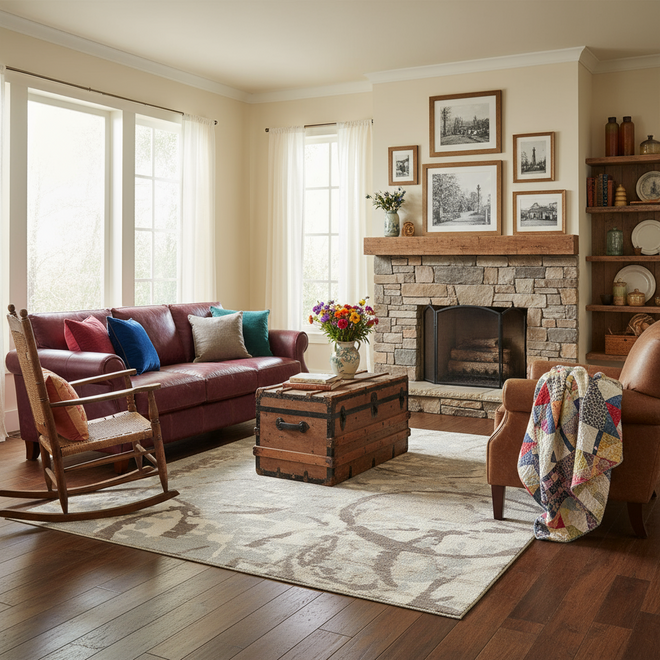
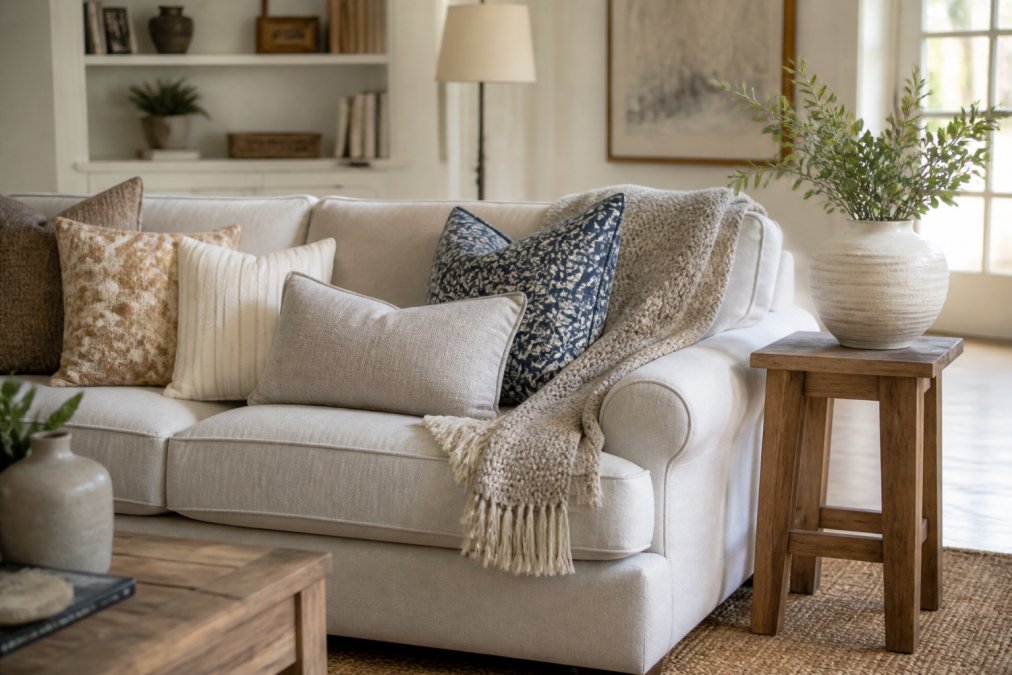
The living room is your best place to experiment. Start with a neutral sofa. Then layer three to five pillows in mixed sizes and textures.
Bedroom
The bedroom works best with fewer, softer contrasts. Stick to two styles and three textures.
- Neutral bedding as your base
- One patterned pillow for interest
- A woven or fuzzy throw at the foot of the bed
- Warm wood or ceramic on the nightstand
Common Mistakes That Make a Mixed Room Look Cluttered
Too many styles is the number one mistake. Three is the ceiling. Four or more and the room loses its design eye.
Other mistakes to avoid:
- Buying everything at once instead of collecting over time
- Mixing too many bold patterns in one small space
- Ignoring scale, so big pieces fight small ones
- Skipping the neutral base, which leaves nothing to anchor the contrast
- Using only one texture, which flattens the whole room
Frequently Asked Questions
What is the 3-5-7 rule in interior design?
The 3-5-7 rule is a styling guideline for grouping accessories in odd numbers: three small items, five medium items, and seven total objects in a display. Odd numbers create visual tension that feels natural rather than rigid. Apply it to a coffee table, bookshelf, or mantel when you mix-and-match home furnishings. Start with a large anchor piece, add medium accents, then finish with small objects like a candle or book stack. Adjust until the arrangement feels balanced from where you usually sit.
How do you mix and match different furniture styles without making a room look cluttered?
Limit yourself to two or three styles per room and repeat one common element, such as a wood tone, a metal finish, or a neutral color, across every piece. Keep surfaces mostly clear and store the rest. A cream throw pillow cover like the Textured Italian Minimalist option from The Finishing Touch Decor ($90) can bridge a modern sofa and a vintage chair because its neutral tone and clean silhouette work with both. Fewer, larger pieces read as intentional; many small pieces read as clutter.
How can I make mismatched furniture look intentional?
Tie mismatched pieces together with a shared palette and consistent scale. Choose a neutral base (white, cream, warm gray) and add two accent colors used at least twice each. Repeat one material, such as cotton or woven wood, in at least three spots. Throw pillow covers are an easy way to do this: the Boho Textured Fringe cover ($20) and the Cream Textured Pattern Nordic cover ($42) share a neutral palette but differ in texture, which makes the mix look deliberate rather than accidental.
What is the best way to balance color and texture when mixing decor styles?
Give color and texture separate jobs. Let color carry the mood (warm, cool, earthy) and let texture carry the interest. A room with a neutral palette can handle many textures without feeling busy. Try pairing a smooth suede cover like the Whipstitch Patchwork Cream Suede Throw Pillow Cover ($76) with a nubby cotton one, then add one patterned accent. Keep patterns to two or three total and vary their scale so they do not compete.
Building a room that feels like you takes more than one shopping trip. It takes a neutral base, two styles, and the patience to layer textures over time. At The Finishing Touch Decor, LLC, we make that easier with a curated collection of throw pillows, vases, wall art, and rugs across French Country, Coastal, Bohemian, and Contemporary styles. Free shipping on orders over $50 means you can start mixing without a big commitment. Shop now and build a space that finally looks like yours.