

Table of Contents
- Step 1: Diagnose Why the Room Feels Dark
- Step 2: Pick the Best Lighting for a Dark Room
- Step 3: Layer Ambient, Task, and Accent Lights
- Step 4: Add Floor Lamps for Dark Corners
- Step 5: How to Brighten a Dark Room With Little Natural Light
- Step 6: How to Use Mirrors to Brighten a Room
- Step 7: Renter-Friendly and Low-Cost Fixes That Work
- Conclusion: A Room-by-Room Plan to Fix Poor Lighting
- Frequently Asked Questions
Last Updated: October 12, 2026
Step 1: Diagnose Why the Room Feels Dark
Most people guess at the problem and buy a lamp. That rarely works. A dark room usually has three causes, and fixing the wrong one wastes money.
Here is the honest truth about how to fix poor lighting in dark rooms: you have to find where the light is going before you add more of it.
Check the Three Sources of Light Loss
Every dark room loses light in one of three places:
- Blocked daylight. Heavy curtains, furniture in front of windows, or dirty glass.
- Weak artificial light. One overhead fixture doing all the work, or bulbs that are too dim.
- Absorbed light. Dark walls, dark floors, and dark furniture soak up what little light exists.
Walk into the room at midday and again at night. If it is bright at noon but gloomy at 8 p.m., your problem is artificial light. If it is dim all day, daylight and absorption are the culprits.
Step 2: Pick the Best Lighting for a Dark Room
The best lighting for a dark room is a mix of three layers, not one bright ceiling light. Layered light fills shadows from multiple angles, so the whole room reads brighter.
Bulbs matter just as much as fixtures. Three numbers decide how a room feels and how well you can see in it.
- Lumens measure brightness. More lumens means more light.
- Color temperature measures warmth, shown in kelvin (K). Lower numbers are warmer and more yellow; higher numbers are cooler and more blue.
- Color rendering index (CRI) measures how accurately a bulb shows colors. A CRI of 90 or higher makes wood tones, fabrics, and skin look natural; a low-CRI bulb can make a well-lit room feel flat and gray.
How Many Lumens Does a Dark Room Need?
A common rule of thumb is 20 lumens per square foot for general living space, and 50 to 80 lumens per square foot for task areas like kitchen counters and home offices. For a 12-by-14-foot living room (168 square feet), that means roughly 3,360 lumens total across all fixtures. That is about four 800-lumen LED bulbs, not one bright ceiling light.
Use this table as a starting point, then adjust up if the room has dark walls or limited daylight.
| Room Type | Lumens Needed | Color Temperature | Best Bulb Type |
|---|---|---|---|
| Living room | 1,000-2,000 | 2,700-3,000K | Warm white LED |
| Bedroom | 500-1,000 | 2,700K | Warm white LED |
| Kitchen | 3,000-4,000 | 3,000-4,000K | Bright white LED |
| Home office | 1,500-2,500 | 3,500-4,000K | Neutral white LED |
| Bathroom | 1,500-2,500 | 3,000-3,500K | Bright white LED |
Lumens, Color Temperature, and What to Buy
Skip the old wattage rules. The U.S. Department of Energy lighting guide explains that lumens, not watts, tell you how bright a bulb actually is.
For a dark room, aim for 2,700K to 3,000K. This warm light feels inviting without turning yellow. Cool light above 4,000K looks harsh in living spaces.
Buy LED bulbs. They run cooler than incandescent bulbs, last far longer, and use a fraction of the energy. Look for a CRI of 90 or higher on the package, and check that the bulb is dimmable if you plan to use a dimmer.
Step 3: Layer Ambient, Task, and Accent Lights
Layered lighting is the practice of combining three light types in one room: ambient light for overall glow, task lighting for focused work, and accent lighting for depth. Each layer covers what the others miss.
Ambient light comes from a ceiling fixture or a large floor lamp. Task lighting covers reading chairs, desks, and kitchen counters. Accent lighting washes walls or highlights art.
Where Overhead Light Fails and Lamps Take Over
A single overhead light throws light straight down. It leaves corners dark and casts shadows on faces. Lamps solve this because they sit at eye level and spread light sideways. Add at least two lamps to any room with one ceiling fixture.
Fixture Placement by Room
Where you put each layer matters more than how bright it is. Use these placements as a starting point.
- Living room. Put a floor lamp in the darkest corner, a table lamp beside the main seating area, and a small accent light aimed at a wall or piece of art. Keep lamp shades at seated eye level so the bulb is not visible.
- Bedroom. Use a central ceiling fixture or a pair of bedside table lamps for ambient light, then add a small reading lamp on one side. Keep the brightest light away from the head of the bed so it does not glare when you are lying down.
- Kitchen. Rely on ceiling fixtures for ambient light, then add under-cabinet lights for counters and a pendant or two over an island. Task light should fall directly on the work surface, not behind you.
- Home office. Place a desk lamp slightly to the side of your dominant hand so it does not cast a shadow on your work. Add a floor lamp or wall light behind you to soften the contrast between the screen and the wall.
Balance Brightness With Glare and Shadows
More light is not always better. A room with one very bright source and dark corners feels uncomfortable because your eyes constantly adjust. The goal is even illumination, not maximum brightness.
- Control glare. Put shades on bare bulbs, aim accent lights at walls instead of into the room, and avoid placing a lamp where you can see the bulb directly from a seated position.
- Soften shadows. Two medium lights on opposite sides of a room cast fewer shadows than one bright light. This is why a pair of matching table lamps often works better than a single large floor lamp.
- Use dimmers. A dimmer lets you lower ambient light in the evening while keeping task light bright. Plug-in dimmers work on lamps without any wiring changes.
Step 4: Add Floor Lamps for Dark Corners
Floor lamps for dark corners are the fastest fix in any room. A corner lamp fills the dead zone that ceiling light never reaches.
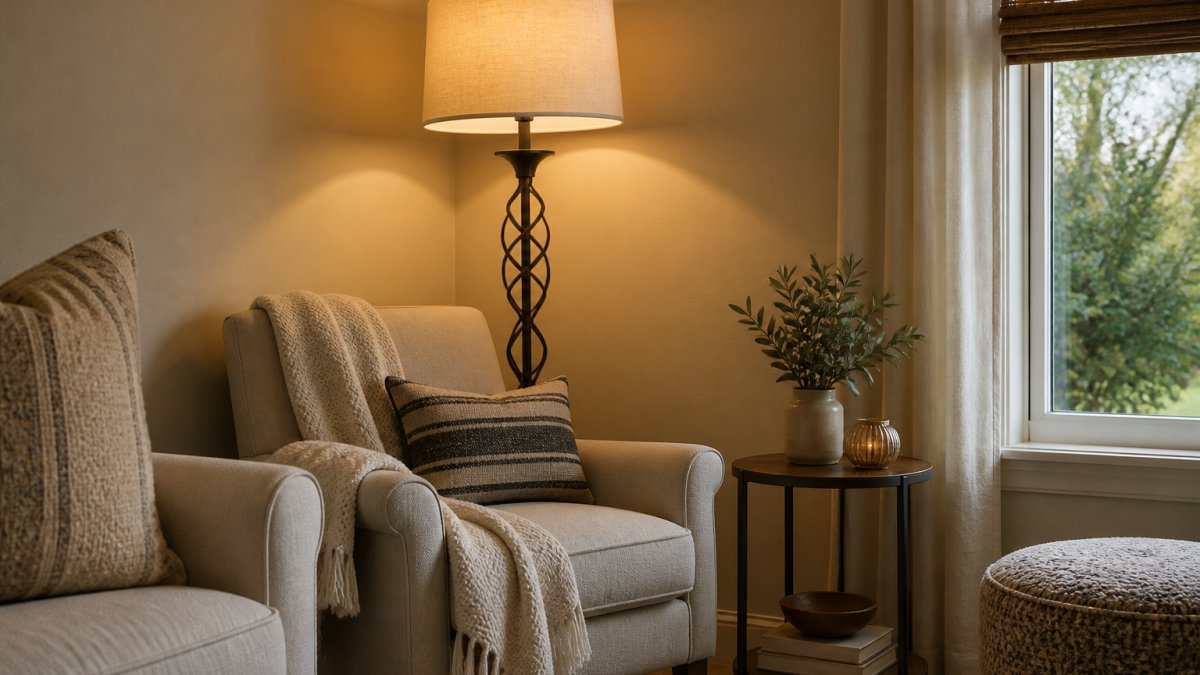
Place the lamp behind or beside a chair, not in front of it. The shade should sit near shoulder height when you are seated.
Our Wabi Sabi Cream Fabric & Iron Spiral Floor Lamp is built for exactly this spot.
Wabi Sabi Cream Fabric & Iron Spiral Floor Lamp →

For a bedside or side table, our Round Rustic Wabi Sabi Ceramic Table Lamp brings a warm, zen-inspired glow to smaller spaces.
Step 5: How to Brighten a Dark Room With Little Natural Light
To brighten a dark room with little natural light, you have to stretch every bit of daylight you get. Three moves do most of the work.
First, clear the windows. Move furniture, plants, and tall decor away from the glass. Even a partial block cuts the light that enters.
Second, swap heavy treatments. Blackout curtains and thick blinds kill daytime light. Switch to sheer curtains or light-filtering shades.
Third, paint lighter. Light-colored paint on walls and a white ceiling bounce light around the room instead of absorbing it.
Clear Windows, Swap Treatments, and Paint Lighter
A white or off-white ceiling reflects light downward, which lifts the whole room. Walls in soft cream, pale gray, or warm white do the same on the sides.
If you rent and cannot paint, focus on the first two steps. They cost little and change a lot.
Step 6: How to Use Mirrors to Brighten a Room
To use mirrors to brighten a room, hang them where they catch light and bounce it back into the space.
Place a mirror on the wall opposite or adjacent to a window. It reflects daylight across the room. In a room with no window, angle the mirror toward your brightest lamp.
Our Gold Metal Sunburst Round 35" Mirror works well above a sofa or in an entryway. The gold frame adds a warm accent while the glass reflects light into the room.

Step 7: Renter-Friendly and Low-Cost Fixes That Work
Renters can fix poor lighting without touching a wall. Every fix below is removable and budget-friendly.
- Add plug-in wall sconces. No wiring needed; they mount with adhesive strips or a small screw.
- Use LED strip lights. Tuck them behind a headboard or under cabinets for hidden glow.
- Swap lamp shades. A lighter shade spreads more light than a dark one.
- Add a dimmer switch. A plug-in dimmer lets you control brightness without an electrician.
- Choose light-colored furniture and decor. Pale upholstery and light wood reflect more light than dark finishes.
- Reduce clutter. Open space lets light travel further across a room.
For a low-cost upgrade, browse our curated home decor accents in French Country, Coastal, and Bohemian styles. Light-toned pieces pull double duty: they decorate and they brighten.

Conclusion: A Room-by-Room Plan to Fix Poor Lighting
Dark rooms rarely need a renovation. They need a plan: diagnose the light loss, layer your lighting, and choose the right bulbs for each space.
If you want pieces that make the fix easy, The Finishing Touch Decor, LLC offers free shipping on orders over $50 and a curated range of lighting and decor. Our floor lamps, table lamps, and mirrors are chosen to warm up dim corners and reflect light where it counts.
Get started with The Finishing Touch Decor, LLC and turn your darkest room into the one you actually want to sit in.
Frequently Asked Questions
How do I get more light into a dark room?
Start by clearing window obstructions and switching to lighter window treatments, then add layered artificial light: an overhead fixture for ambient light, a floor lamp or two for corners, and a table lamp for task lighting. Use bulbs rated around 800 to 1,100 lumens in warm white (2700K-3000K) for living spaces. Place a large mirror opposite the brightest window to bounce daylight deeper into the room, and keep walls and ceilings in light, reflective paint colors. Most rooms need two to three light sources, not one bright ceiling light.
What is the best lighting for a dark room?
Layered lighting works best: ambient light from a ceiling fixture or floor lamp, task lighting for reading or work, and accent lighting for depth. In a room with little natural light, choose LED bulbs in the 2700K to 3000K range with high lumens (800-1,600 depending on room size) and add a dimmer switch so you can adjust brightness. A floor lamp with a fabric shade, like the Wabi Sabi Cream Fabric & Iron Spiral Floor Lamp, spreads soft ambient light across 5-10 square meters without harsh glare.
Where should lamps go in a dark room?
Place floor lamps in dark corners where ceiling light does not reach, and position table lamps beside seating, beds, or work surfaces for task lighting. Keep lamp shades at or below eye level when seated to reduce glare, and aim light toward the ceiling or a wall to diffuse it. In larger rooms, use two or three lamps instead of one, spacing them so pools of light overlap. A corner floor lamp plus a table lamp on the opposite side usually evens out brightness distribution.
Do mirrors make a dark room look brighter?
Yes, when placed correctly. A mirror reflects whatever light hits it, so hang a large mirror on the wall opposite or adjacent to your brightest window to bounce daylight across the room. Avoid placing mirrors where they reflect dark walls or unlit corners, since that just doubles the darkness. Pair mirrors with light-colored walls and gloss or satin finishes, and use them alongside lamps rather than as a replacement. A 35-inch round mirror works well above a sofa or in an entryway.