

Last Updated: October 22, 2026
Quick Summary
Buying home decor online successfully requires planning your style and needs before shopping, measuring your room and delivery path carefully, and verifying seller reliability and product quality through detailed photos and reviews. Start with a checklist of specific items, dimensions, and your color palette to avoid impulse purchases that don't fit your space or style.
- Measure your room dimensions, doorways, hallways, and stairwells before ordering to ensure pieces fit through your delivery path.
- Create a style guide with 2-3 main colors, your primary style, and materials you love to keep purchases intentional and cohesive.
- Read both five-star and three-star reviews and look for customer photos to see how items actually look in real homes.
- Check seller legitimacy by verifying a physical address, customer service contact information, and independent reviews before paying.
- Prioritize investment pieces like rugs and statement art, then save money on accent pieces like pillows and vases.
Table of Contents
- Know What You're Looking For Before You Shop
- How to Measure a Room for Furniture and Decor Placement
- Define Your Style and Set Design Guidelines
- Create a Home Decor Shopping Checklist
- How to Check Home Decor Quality Online
- Finding Affordable Home Decor Online Without Sacrificing Style
- Evaluate Seller Reliability and Protect Your Purchase
- Frequently Asked Questions
Know What You're Looking For Before You Shop
The biggest mistake when buying home decor online is clicking "add to cart" without a plan, leaving you with pieces that don't fit, clash, or sit unused.
Start by asking what you actually need: filling wall space, adding texture to a sofa, or creating a cohesive look in one room or across your home.
Next, identify the styles that appeal to you, French Country, Coastal, Bohemian, or minimalism, so every piece feels intentional rather than random.
Finally, identify the items with the biggest impact. A few statement pieces, a bold rug, an eye-catching throw pillow, meaningful wall art, transform a room more than many small items.
How to Measure a Room for Furniture and Decor Placement
Getting measurements right is non-negotiable when buying home decor online. Accurate dimensions are your only safeguard against ordering something too large, too small, or wrong for your space, and you must also measure the delivery path.
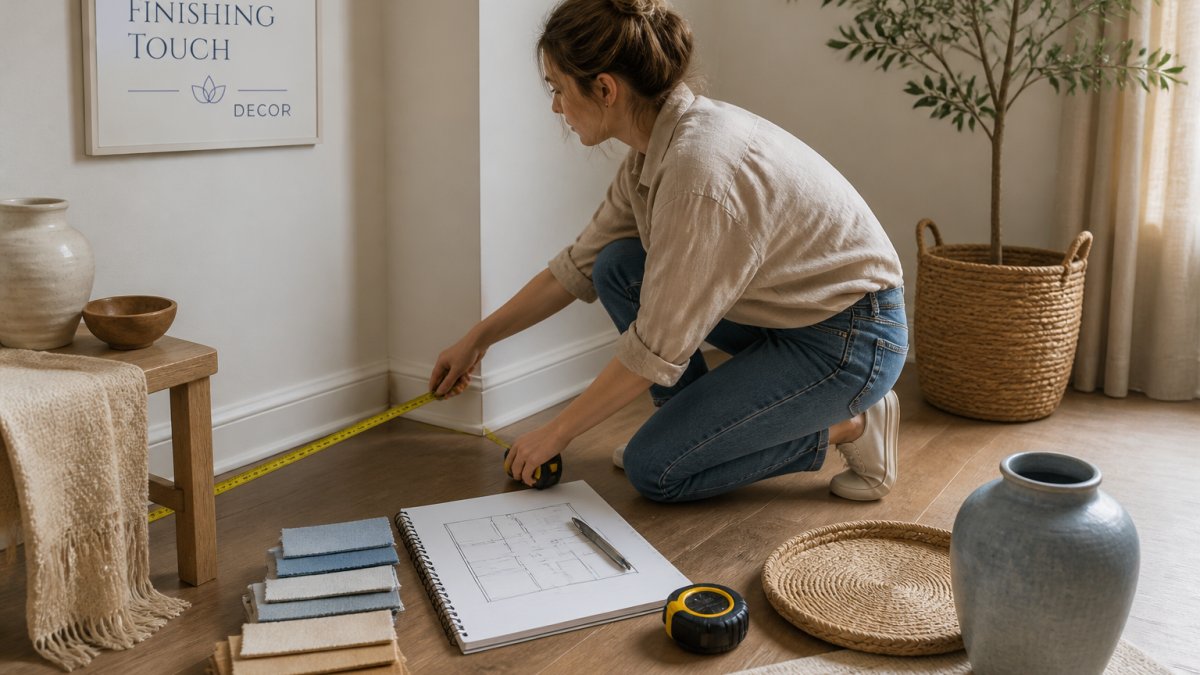
Measure the room, not just the wall
Measure wall height and width, note existing furniture dimensions, and check doorways and windows to know what wall space is available.
For furniture, measure the space and the item itself (length, width, height), leaving a few inches of breathing room.
For wall art or a large mirror, measure from the floor up.
For rugs, measure your seating area. A rug should extend under at least the front legs of your furniture; too small a rug makes a room feel disconnected.
Measure the delivery path before you order
This is the step most online buyers skip, and it causes the most expensive surprises. A piece can fit your room perfectly and still never make it inside.
Measure and record:
- Front door width and height (the clear opening, not the frame)
- Every interior doorway the item must pass through
- Hallway width at the narrowest point
A common pattern: a sofa fits the living room wall but can't clear the elevator door or the turn at the top of a staircase. Delivery teams generally won't remove doors or windows, and you may be responsible for return shipping.
Factor delivery and assembly into the total cost
Before checkout, confirm what the delivery service includes. Curbside leaves the item at the street or loading dock; threshold brings it inside the entry; room-of-choice places it where you want it; white-glove typically adds assembly and packaging removal.
Ask the seller directly:
- Which delivery tier is included in the listed price?
- Is there an upcharge for stairs, elevators, or inside placement?
- Does the carrier call to schedule, and what is the delivery window?
Also confirm return-shipping costs for large items. Furniture returns are often expensive because the buyer pays freight both ways, and some sellers charge a restocking fee.
Use a floor plan to test placement
Sketch a to-scale floor plan on graph paper or use a free room-planning tool. Cut paper templates to each piece's footprint and move them around the plan to catch crowding, blocked walkways, and pieces too close to a heat source. Mark door swings and clearance for drawers and cabinet doors. A template test takes minutes and prevents the most common online furniture regret: a piece that fits the wall but ruins the room's flow.
Define Your Style and Set Design Guidelines
Style is personal, but it works best when consistent, not perfectly matched, but sharing a common thread in color, texture, or era.
Choose a primary palette of 2-3 main colors to anchor the room, plus 1-2 accents. When browsing home decor online, this palette keeps you from buying pieces that won't work together.
Mix textures, a smooth ceramic vase with a woven throw pillow, for depth, but avoid too many competing textures or the room feels chaotic.
Set a style guide for yourself. Write down:
- Your primary style (French Country, Coastal, Bohemian, etc.)
- Your color palette (main colors + accents)
- Materials you love (wood, metal, ceramic, fabric)
This guide becomes your filter. When you're tempted by something beautiful but totally wrong for your space, your guide helps you say no.
A cohesive room doesn't require matching sets. It requires intentional choices guided by a style you've defined in advance. Our curated collections in French Country, Coastal, Bohemian, and Contemporary styles make it easier to find pieces that naturally work together.
Create a Home Decor Shopping Checklist
A home decor shopping checklist keeps you focused and prevents impulse purchases.
Before you start browsing, create your checklist:
- List the specific items you need (rug, throw pillows, wall art, vase, etc.)
- Note the dimensions each item should be
- Write your color palette and style guidelines
Refer back to your checklist as you shop. If an item doesn't check multiple boxes, skip it, this discipline prevents the cluttered, mismatched look that comes from buying whatever catches your eye.
When buying home decor online, this checklist also helps you compare options at a glance.
How to Check Home Decor Quality Online
You can't touch items through a screen, but you can assess quality through product photos and descriptions.
Look for multiple angles and close-ups showing stitching, texture, and finish.
Read the material description: solid wood or veneer, real leather or faux, natural fiber or synthetic.
Check weight and construction details.
Read both five-star and three-star reviews.
Look for quality indicators in the listing:
- Detailed material composition
- Clear, multiple product photos
- Specific dimensions and weight
Our curated selection emphasizes quality pieces designed to elevate your space.
Finding Affordable Home Decor Online Without Sacrificing Style
Budget-friendly doesn't mean cheap-looking. It means being strategic about where you spend and where you save.
Prioritize investment pieces you'll see every day and that set the room's tone.
Shop seasonal sales and clearance.
Look for bundle deals when furnishing an entire room.
Mix price points: pair one or two higher-quality pieces with several affordable accents for a curated look without breaking your budget.
| Strategy | Best For | Savings Potential |
|---|---|---|
| Investment pieces | Statement items (rug, large art) | Medium |
| Accent pieces | Small decor (pillows, vases) | High |
| Seasonal sales | Flexible timing | High |
| Bundle deals | Complete room updates | Medium |
| Price mixing | Balanced budgets | High |
We offer affordable home decor that doesn't compromise on style.
Evaluate Seller Reliability and Protect Your Purchase
Not all online retailers are equal. Before you pay, evaluate the seller's reliability and the listing itself, a polished storefront can hide a thin operation, and a misleading listing can cost you the item price plus return freight.
Verify the seller's business basics
Check the retailer's business basics: how long they've been in business, a physical address, and customer service contact information. Legitimate retailers make it easy to reach them with a phone number, mailing address, and a real customer service email.
Read reviews on independent platforms, not just those embedded on the seller's page. Multiple complaints about the same issue, damaged items, misrepresented colors, refused returns, suggest a real problem.
Inspect the listing for reliability signals
A reliable listing gives you enough information to judge the item without seeing it in person. Check for:
- Multiple clear photos from different angles, including close-ups of seams, finishes, and hardware
- Consistent product photos across the listing and the seller's other listings (mismatched backgrounds or lighting can indicate stock photos pulled from other sources)
- Specific material composition (solid wood vs. veneer, real leather vs. faux, natural fiber vs. synthetic)
If the listing uses vague language, reuses manufacturer photos without adding its own, or omits dimensions, treat it as a warning sign. Cross-check the item against the manufacturer's own site when possible.
When checking home decor quality online, look for customer photos in reviews. Real people's photos show how items actually look in homes, how colors appear in different lighting, and whether construction holds up over time.
Pay safely and protect your information
Use a payment method with recourse. Credit cards and major payment platforms generally offer dispute and chargeback protections if an item never arrives or arrives significantly not as described. Avoid wire transfers, money orders, or peer-to-peer apps with unknown sellers.
Before entering payment details, confirm the checkout is secure, look for "https" and a lock icon. Be cautious of storefronts asking for unusual information, pressuring you with countdown timers, or routing you to a third-party checkout that doesn't match the seller's domain.
Handle damage and returns with documentation
Inspect items immediately on arrival, before the delivery team leaves if possible.
Contact the seller right away with photos and your order number. Reputable retailers will replace damaged items or issue refunds, but documentation speeds the process.
Before buying home decor online, verify the seller's legitimacy and the listing's completeness. Check for a physical business address, clear contact information, independent reviews, specific dimensions and materials, and a secure checkout. Never buy from sellers with no verifiable history or contact information, and never pay by wire transfer or peer-to-peer app to an unknown seller.
Keep the original packaging until you're sure you're keeping the item. Many retailers require returns in original packaging, and replacement packaging for large furniture can be expensive or impossible to source.
Frequently Asked Questions
What should I check before ordering furniture or decor online?
Before ordering, verify the product dimensions against your room measurements, check the material and care instructions, read customer reviews for quality feedback, confirm the return policy and restocking fees, review shipping costs and delivery timelines, and examine product photos from multiple angles. Also confirm the seller's return window and whether they cover damage during shipping. Taking these steps prevents costly mistakes and ensures the items will work for your space.
How can I tell if home decor will fit my space?
Measure your room and available wall or floor space using a tape measure, then compare those dimensions to the product specifications listed online. Create a floor plan sketch to visualize scale and proportion. Account for doorways, windows, and existing furniture. Many retailers provide dimension details in their product listings. If specifications aren't clear, contact the seller before purchasing. This prevents ordering pieces that won't fit or that look disproportionate in your room.
How can I judge the quality of home decor from product photos?
Look for multiple high-resolution photos showing the item from different angles and in different lighting. Read customer reviews that mention durability and material quality. Check the product description for material composition, weight, and construction details. Look for close-up photos that show stitching, seams, or texture. Compare similar items across retailers to understand quality differences. Photos with props or styled settings help you visualize how the piece functions in a room, but focus on details that reveal craftsmanship and material quality.
What is the best way to avoid color and material uncertainty when buying decor online?
Request fabric swatches or samples from the retailer if available. Review customer photos showing the item in real homes and different lighting conditions. Understand your room's natural and artificial lighting before ordering. Read reviews specifically mentioning color accuracy and whether items matched product photos. Order from retailers with generous return policies so you can return items that don't match your expectations. Consider starting with smaller, less expensive accessories to test how colors and materials work in your space before investing in larger pieces.