

Table of Contents
- Start With the Right Vase Size for a Console Table
- How to Balance Decor on a Console Table Using Symmetry and Asymmetry
- Vase Grouping Formulas for Different Table Widths
- Narrow Console Table Decorating Ideas That Actually Fit
- How to Decorate a Narrow Entry Table With Vases and Everyday Objects
- Choosing Vase Shapes, Finishes, and Fillers That Hold Their Own
- Frequently Asked Questions
Last Updated: October 17, 2026
Start With the Right Vase Size for a Console Table
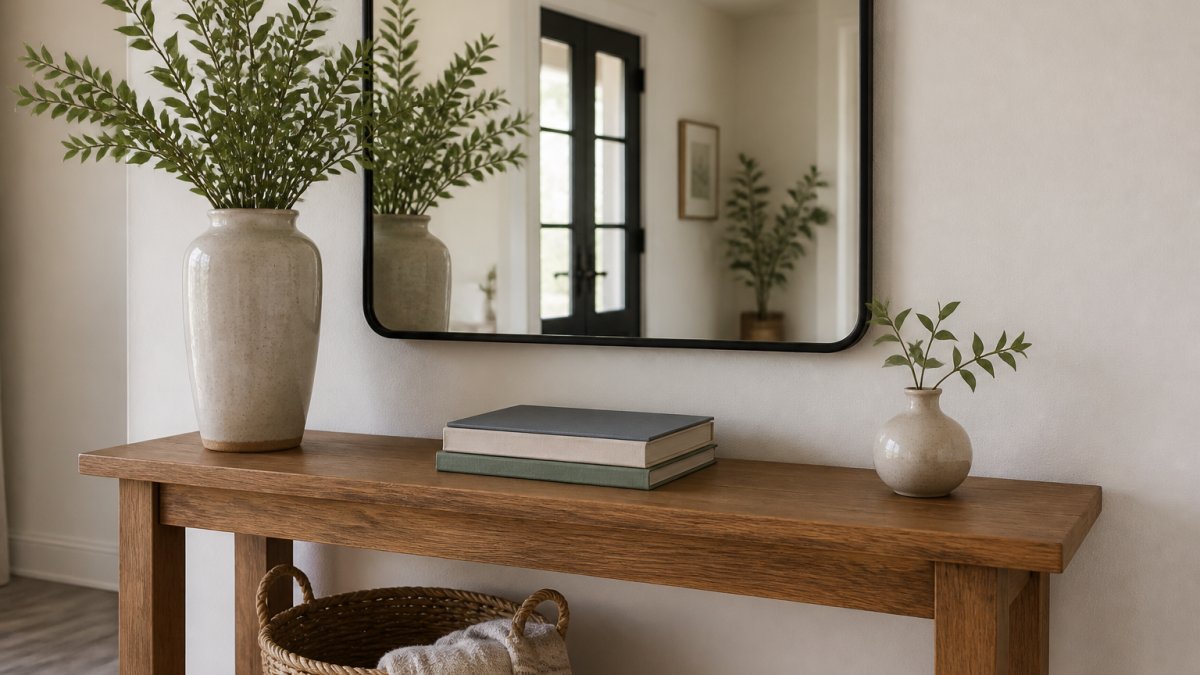
A narrow console table rewards restraint, and the right vase size comes down to two numbers: height and footprint. Get those wrong and even a beautiful piece looks crammed.
A vase should take up no more than a third of the table's depth. On a standard narrow top, that leaves room for books, a lamp, or a small plant without a traffic jam of objects.
Height matters just as much. Aim for a vase that fills roughly two-thirds of the space between the tabletop and whatever hangs above it. Too short and it disappears. Too tall and it crowds the sightline.
Height and Width Rules That Keep a Narrow Top From Feeling Crowded
Most narrow console tables sold in the United States run 12 to 16 inches deep and 30 to 60 inches wide, with a top height around 30 to 34 inches. Those are the numbers to design around, not the vase's catalog dimensions.
Use this depth math before you buy:
- 12-inch-deep top: keep the vase footprint at 4 inches or less in diameter, and leave at least 8 inches of clear depth in front of it for a tray, books, or a lamp base.
- 14-inch-deep top: a 4- to 5-inch footprint works, with 9 inches of clear depth remaining.
- 16-inch-deep top: you can go up to a 5- to 6-inch footprint and still keep 10 inches of usable depth.
For height, measure from the tabletop to the bottom edge of the mirror or artwork above. If that gap is 30 inches, a vase in the 18- to 22-inch range fills roughly two-thirds of the space without touching the sightline. If the gap is 24 inches, stay under 16 inches. If nothing hangs above the table, cap the vase at about 24 inches so it does not dominate a walkway.
Think in zones rather than one long row:
- Back zone: tall vase or branches, kept close to the wall
- Middle zone: stacked books or a low bowl
- Front zone: a small vase or a single sculptural object
Leave at least a hand's width of empty tabletop between groupings. Negative space is what makes a narrow surface read as styled instead of stuffed.
Proportion and Stability: Why a Top-Heavy Vase Tips
A tall vase with a wide, heavy top will tip if the base is small. Wide shoulders plus a narrow foot equals wobble, especially on a table people brush past. Weight the bottom instead: a heavier base, a wider foot, or a few stones inside a hollow vase.
A quick stability test: set the vase on the table and press the rim with one finger. If it rocks before you apply real pressure, the base is too narrow for the height. As a rule of thumb, the base diameter should be at least one-third of the vase's height. A 21-inch vase wants a foot of about 7 inches across; a 12-inch bud vase can get by with a 4-inch base.
Depth affects tipping too. A vase placed near the front edge of a 12-inch-deep table has less room to recover if bumped. Keep tall vases in the back third of the tabletop and reserve the front edge for low, stable objects.
How to Balance Decor on a Console Table Using Symmetry and Asymmetry
Balance is not the same as matching. Symmetry mirrors objects left and right, which feels calm and formal. Asymmetry uses different sizes and shapes to create the same visual weight, which feels relaxed and modern.
For a narrow console, asymmetry usually works better. Matching pairs eat up width fast. A tall vase on one end and a low stack of books on the other keeps the surface open.
Find Your Focal Point Before You Place a Single Vase
Pick one anchor piece first: the largest or most eye-catching object. Everything else supports it. If you start with the small pieces, you end up with a cluster of clutter and nowhere for the star to sit.
Layer Objects to Create Depth Without Clutter
Depth comes from front-to-back layering, not side-to-side crowding:
- Lean a small piece of artwork against the wall behind the vase
- Stack two or three books under a low bowl
- Tuck a trailing plant at the edge so it softens the line
Vase Grouping Formulas for Different Table Widths
Grouping formulas take the guesswork out of how many vases a table can hold. Use the table width as your guide, then apply the spacing rules below so the arrangement does not collapse into a row of knickknacks.
| Table Width | Vase Count | Arrangement | Target Negative Space |
|---|---|---|---|
| Under 30 inches | 1 | One statement vase, offset from center | At least 10 inches of clear top on the open side |
| 30-42 inches | 2 | Tall vase plus small bud vase, opposite ends | 12-16 inches between the two vases |
| 42-54 inches | 3 | Tall, medium, and small in a staggered trio | 6-8 inches between each vase, 10 inches at each end |
| Over 54 inches | 3-4 | Grouped trio plus one solo accent | 8-10 inches between the trio and the solo piece |
Odd numbers generally look more natural than even ones. A trio of different heights reads as collected, not purchased as a set. The exception is a deliberate pair flanking a mirror or artwork, where symmetry is the point.
Retro Cottage Hand-Painted Ceramic Bud Vase →
The Spacing Formula for One, Two, or Three Vases
Measure the usable top width first: table width minus any lamp or tray you plan to keep. Then divide that space into zones.
- One vase: place it at roughly the one-third mark from one end, not dead center. Dead center on a narrow table looks like a hotel lobby. Leave the remaining two-thirds open for a book stack, a bowl, or a lamp.
- Two vases: put the taller vase at one end and the shorter at the other, with 12 to 16 inches of clear top between them. If the table is under 36 inches wide, two vases plus a third object will feel crowded; drop to one vase and one low object instead.
- Three vases: stagger heights so the tallest sits at one end, the medium in the middle, and the smallest at the opposite end. Keep 6 to 8 inches between each vase and at least 10 inches of clear top at each end. This is the formula that fits most 42- to 54-inch consoles.
For a three-vase trio, a common pattern is heights of roughly 18, 12, and 8 inches. That gives a clear step-down without any single piece disappearing.

When to Break the Formula
If the console sits in a hallway narrower than 36 inches, treat it as a one-vase table no matter how wide the top is. People walking past will brush the arrangement, and a trio becomes a tipping hazard. Similarly, if a mirror or artwork hangs low above the table, cap the tallest vase so it clears the bottom edge by at least 4 inches.
Narrow Console Table Decorating Ideas That Actually Fit
The best narrow console table decorating ideas share one trait: they respect the depth limit. Anything deeper than a third of the surface starts to feel like it is falling off the edge.
Try these combinations:
- A tall vase with dried branches, a stack of three books, and a small ceramic dish
- A single large vase flanked by a low plant and a leaning frame
- A trio of small vases with one sculpture and nothing else
Mix and match heights, but keep the color palette tight. Two or three tones hold a narrow top together.

How to Decorate a Narrow Entry Table With Vases and Everyday Objects
An entry table has to work harder than most surfaces. It holds keys, mail, and whatever lands when you walk in. So how do you decorate a narrow entry table without losing function?
Split the surface. Reserve one end for decor and leave the other end clear for daily drop items. A tray corrals keys and mail so they do not scatter across the whole top.
For the decor end, a tall vase with artificial willow branches adds height without needing water or upkeep. Pair it with a small dish for change and a low bowl for sunglasses.
Renters take note: none of this requires a single nail. Everything sits on the table or leans against the wall, so it moves with you.
Choosing Vase Shapes, Finishes, and Fillers That Hold Their Own
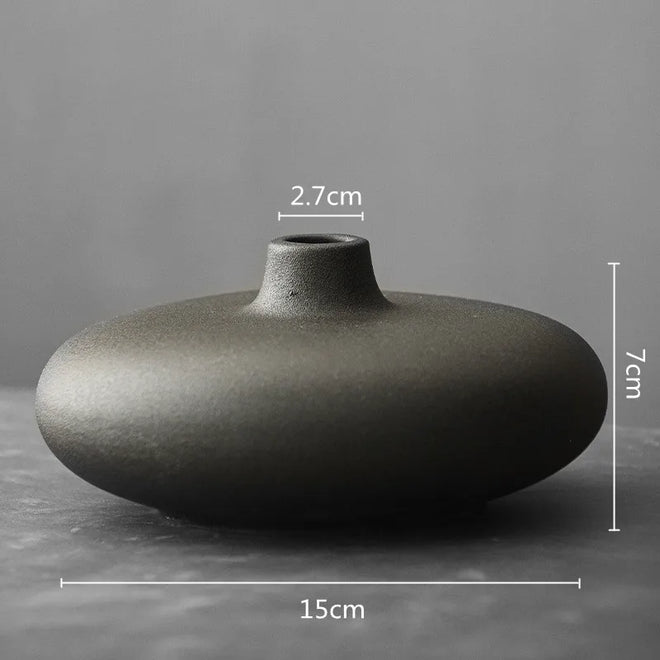
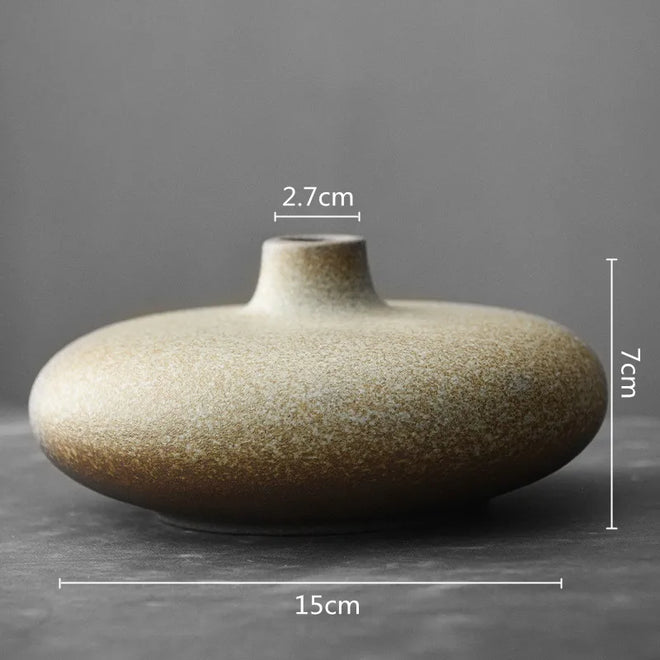
Shape and finish decide whether a vase reads as art or as an afterthought. Tall and slender suits narrow tables because it adds height without width. Round and squat works as a low accent beside a taller piece.
Finish sets the mood:
- Matte ceramic: soft and understated, great for a calm look
- Glazed or brushed: catches light and adds polish
- Hand-painted: brings color and character to a neutral palette
Fillers matter too. Dried florals and branches hold their shape for months. Empty vases can stand alone as sculpture if the shape is strong enough. For a hand-painted option, our Retro Cottage bud vase works well as a small accent beside a taller piece, and our set of three clay jug vases gives you instant height variation in one purchase.

Frequently Asked Questions
How many vases should you put on a narrow console table?
Most narrow tables look best with one to three vases. A single statement vase works when the table is under about 36 inches wide. For a 48-inch table, try a tall vase paired with one small vase for an asymmetric look. At 60 inches or more, a group of three in varied heights fills the space without crowding. Always leave at least 2 inches of clearance from the front edge so nothing gets knocked over.
What size vase works best on a narrow console table?
Aim for a vase that is roughly one-third the height of the table plus whatever sits above it, and no wider than one-third of the tabletop depth. On a typical 12-inch-deep narrow console table, keep the vase base under 4 inches across so there is room for books or a lamp beside it. Tall vases belong at the ends, small vases near the center.
How do you create balance when styling a console table?
Balance comes from visual weight, not identical pairs. Put your tallest, darkest, or most textured piece on one side and a lighter cluster of two or three smaller objects on the other. Keep the total height on each half roughly equal even when the object count differs. This asymmetry trick is what makes a narrow console table look intentional rather than lopsided.
What can you place beside a vase on a console table?
Stacked books, a small plant, a sculpture, a lamp, or a shallow decorative bowl all work beside a vase. Choose items with different textures and heights so the arrangement reads as layered. On a narrow top, keep accessories shallow, ideally under 6 inches deep, so there is still walking clearance. Dried florals or a willow branch filler can also extend a vase's height without adding width.
A narrow console table can look intentional with a little planning, but most people stall on where to start. The Finishing Touch Decor, LLC makes it easier with a curated range of vases across French Country, Coastal, Bohemian, and Nordic Scandi styles, plus free shipping on orders over $50. Start with one anchor vase, build your trio, and let the negative space do the rest. Browse the collection and find the pieces that fit your table.