

Table of Contents
- Start With a Floor Plan Before You Move a Single Piece
- 1. The Sleeping Nook: Tuck the Bed Into the Corner
- 2. The Sofa-Back Divide: Let Seating Do the Work
- 3. How to Divide a Studio Apartment With a Folding Screen
- 4. Multifunctional Furniture for Studio Apartments That Earns Its Footprint
- 5. Small Studio Apartment Layout Ideas for Long, Narrow Rooms
- 6. The Zone Map: Separate Living, Sleeping, and Eating Areas
- 7. Rental-Friendly Arrangements You Can Undo in an Afternoon
- What Matters Most
- Frequently Asked Questions
Last Updated: October 15, 2026
Start With a Floor Plan Before You Move a Single Piece
One of the 7 ways to arrange furniture in a tiny studio is to draw the room on paper before you touch a single piece.
This guide from The Finishing Touch Decor, LLC covers 7 ways to arrange furniture in a tiny studio, from corner sleeping nooks to rental-friendly setups you can undo in an afternoon.
A common mistake is buying furniture before mapping the space. Most people do the reverse and then wonder why nothing fits.
1. The Sleeping Nook: Tuck the Bed Into the Corner
The corner sleeping nook is the workhorse of studio apartment furniture layout. Push the bed into the least-trafficked corner, ideally the one farthest from the entry door, and treat that zone as its own room.
A bed placed diagonally across a corner frees up wall space on both sides. A bed pushed flat against two walls frees up the most floor.
Measurements That Keep a Bed From Swallowing the Room
Leave at least 24 inches of walking space on the open side of the bed. Thirty inches is better if you share the studio with someone. Keep 36 inches of clearance in front of any closet or dresser drawer so it can open fully.
For a twin bed, plan for roughly 39 by 75 inches of floor. A full bed runs about 54 by 75 inches. Sketch those footprints to scale before you commit.
2. The Sofa-Back Divide: Let Seating Do the Work
A sofa floating with its back to the bed is the simplest way to divide a studio apartment without building anything.
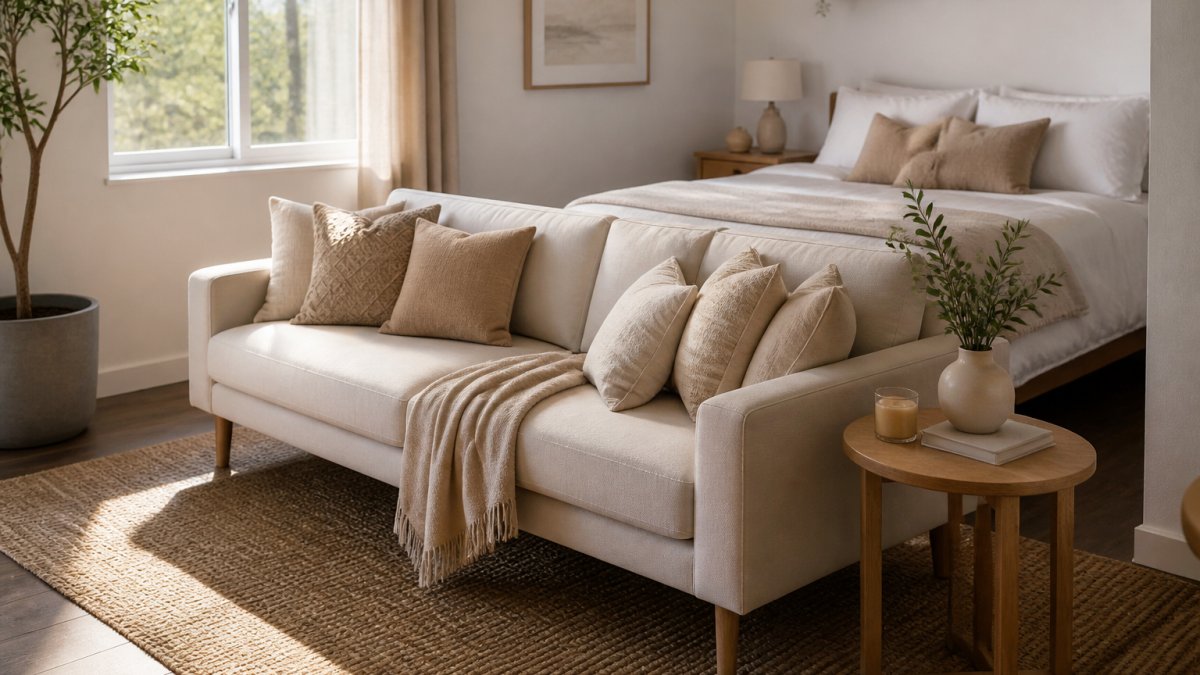
A low-backed sofa works best here. A tall, overstuffed one blocks light and makes both halves feel like tunnels.
What most guides miss is the gap. Leave 30 to 36 inches between the sofa back and the bed so you can walk behind it comfortably.
3. How to Divide a Studio Apartment With a Folding Screen
A folding screen is the most reversible way to divide a studio apartment. It creates a visual wall in seconds, folds flat when you move, and never touches your security deposit.
Place the screen parallel to the bed rather than across the middle of the room. Angling it slightly toward a corner softens the look and keeps the walking path clear.
Privacy, Light, and Airflow Trade-Offs
Every divider trades something. A solid screen gives privacy but blocks daylight and stops air from moving. A slatted or open-weave screen lets light and air through but hides less. Choose based on which matters more: sleeping privacy or a bright, breezy room.
4. Multifunctional Furniture for Studio Apartments That Earns Its Footprint
Multifunctional furniture for studio apartments only earns its place if it does two jobs well. An ottoman that stores blankets and seats a guest is worth its footprint. A decorative table that holds one candle is not.
Our picks from our own collection, all built for tight rooms:
| Piece | Price | Second Job | Best For |
|---|---|---|---|
| Upholstered Soft Close Storage Ottoman Bench | $398.00 | Hidden blanket and pillow storage | Foot-of-bed seating |
| Modern Industrial PU Leather & Steel Swivel Ottoman | $121.20 | Extra seat, 360-degree swivel | Small seating area |
| Scandinavian Solid Rubber Wood Small Side Table | $289.00 | Coffee table or bedside surface | Beside a sofa or bed |
| Round Large Pillow Floor Seating Meditation Pillow | $34.00 | Floor seating, no chair needed | Low-traffic corners |
The storage ottoman is the one we recommend most often. It hides the clutter that makes small rooms feel smaller, and the soft-close lid means no slamming.

5. Small Studio Apartment Layout Ideas for Long, Narrow Rooms
Long, narrow studios punish furniture placed across the width. Run your main pieces along the long walls instead, and keep a single clear path from the door to the far window. The goal is one unobstructed corridor, not a series of obstacles you sidestep every morning.
Measure the Corridor First
Before you place anything, measure the narrowest point of the room, usually between the entry door and the opposite wall, or between a kitchen counter and the facing wall.
- Main walking path: keep it at least 36 inches wide. This is the clearance most people find comfortable for carrying groceries, laundry, or a bike through the room.
- Secondary paths (between the bed and a wall, or around a coffee table): 24 to 30 inches is workable. Below 24 inches, you will turn sideways to pass.
- Door swings: a standard interior door needs roughly 32 to 36 inches of clear arc. Never park a chair, hamper, or floor lamp inside that arc.
If your narrowest point is under 36 inches, you cannot fit a full walking path plus furniture on both sides. Choose one wall for storage and keep the opposite wall clear.
The Three-Zone Run
Split the length into thirds: entry and kitchen at one end, living in the middle, sleeping at the far end. A rug under the living zone marks where one area ends and the next begins.
Round Palm Straw Japanese Tatami Seat Pillow →
A common pattern is to place the bed against the short far wall, headboard centered, so the sleeping zone reads as a destination rather than a pass-through.
When the Only Window Is at the Far End
If daylight enters from the far end, do not block it with a tall dresser or a bookcase. Keep the window wall low, a bench, a low console, or nothing at all, and let the light travel down the corridor. A tall piece near the window turns the far third into a cave.
When the Entry Is Mid-Wall
Some narrow studios have the front door in the middle of a long wall rather than at the end. In that case, treat the entry as the center of a T and run zones to either side: sleeping on one side, living on the other. Keep a 36-inch landing zone inside the door so you are not stepping directly into the bed or the sofa.
6. The Zone Map: Separate Living, Sleeping, and Eating Areas
A zone map assigns every activity its own patch of floor. Living, sleeping, and eating each get a defined area, even in a single open room. What most guides skip is the part that actually decides whether a zone map works: the trade-offs between privacy, daylight, and airflow, and the measurements that keep each zone usable.
Draw the Map Before You Shop
Sketch the room to scale on graph paper, one square per foot. Mark the door swing, every window, the radiator, and any closet. Then block out three rectangles, sleeping, living, eating, and see what is left for walking. If the leftover paths are under 24 inches, the map is too ambitious; merge two zones or shrink one.
The Three Trade-Offs Every Divider Makes
Any boundary you add, a sofa back, a screen, a bookcase, trades one comfort for another. Decide which matters most to you:
- Privacy vs. daylight. A solid divider gives sleeping privacy but blocks light from reaching the rest of the room. A slatted, open-weave, or low divider lets light through but hides less. If your only window is on the living side, a tall solid divider will darken the bed area all day.
- Privacy vs. airflow. Solid dividers stop cross-breezes. In a studio with one window and one door, a full-height solid screen can leave the sleeping zone stuffy. Open frames and low pieces keep air moving.
- Definition vs. floor space. Every divider eats floor. A sofa back needs 30 to 36 inches behind it to walk through; a screen needs a few inches to stand and a clear path around it. If the room cannot spare that, use a rug edge or a ceiling-mounted curtain track instead, both define a zone without consuming a walking lane.
Zone Edges That Do Not Eat Floor
When you cannot spare inches for furniture dividers, define zones with edges that live on the floor or ceiling:
- A rug edge under the living zone.
- A change in flooring or a runner marking the entry.
- A pendant or floor lamp that pools light over one activity.
These edges tell your brain "this is a different room" without stealing a walking path.
How Many Zones Is Too Many
Three zones is the sweet spot. More than that and the room feels chopped up, and each zone becomes too small to use. If you need a fourth function, a desk, a workout corner, fold it into an existing zone rather than carving out new floor. A desk at the end of the living zone, or a mat that rolls up under the bed, keeps the map readable.
7. Rental-Friendly Arrangements You Can Undo in an Afternoon
Renters need layouts that leave no holes and no damage. Freestanding dividers, area rugs, and furniture placement do all the work without a single nail.
Avoid adhesive wall hooks for anything heavy, and skip mounting shelves into drywall you do not own. If you want art on the wall, lean a framed piece on a console or use a floor mirror instead.
What Matters Most
The best arrangement is the one that keeps you moving freely through the room.
When you are ready to finish the space, The Finishing Touch Decor, LLC carries the accents that pull a small room together, from floor pillows and ottomans to rugs and side tables.
U.S. Department of Housing and Urban Development guidance on rental housing
Frequently Asked Questions
Where should a bed go in a studio apartment?
Place the bed in the corner farthest from the entry door, ideally against the longest uninterrupted wall. This keeps the first thing you see when you walk in a living space rather than a mattress. If the room is long and narrow, set the bed on the short wall at the far end and build the seating area in front of it. Leave at least 24 inches of walking space on the open side of the bed so you can make it without climbing over furniture.
How do you divide a studio apartment without making it feel smaller?
Use low, see-through dividers instead of full walls. A sofa back, a folding screen, a bookshelf with open shelves, or a rug change can separate zones while keeping sightlines open. Keep the tallest divider under about 48 inches so light from the window still reaches the back of the room. Anything solid and floor-to-ceiling chops the space into two cramped boxes and blocks airflow from your only window.
What furniture works best in a small studio apartment?
Pieces that do two jobs. An upholstered storage ottoman bench holds blankets and doubles as seating or a coffee table surface. A small side table can serve as a nightstand, a plant stand, or a spot for a laptop. A pouf moves from footrest to extra seat when guests arrive. Before buying anything, measure your floor plan and confirm each piece has a second use, or it will cost you floor space you cannot get back.
How do you arrange furniture in a studio with an awkward layout?
Work around the fixed points first: doors, windows, radiators, and outlets. Sketch those on graph paper, then place the largest piece, usually the bed, in the spot with the fewest obstructions. Build the rest of the layout in a loop so you never have to cross one zone to reach another. If a column or odd alcove breaks the room, turn it into a feature by tucking a reading chair or a slim console into it rather than fighting it.
Can I rearrange a tiny studio if I rent and cannot drill into walls?
Yes. Every layout here works without a single hole in the wall. Use freestanding folding screens, sofa backs, and tall bookcases as dividers. Rugs define zones on their own because the color and texture change tells your eye where one area ends and the next begins. Command strips and leaning mirrors handle wall decor. When you move out, everything lifts away in an afternoon and your deposit stays intact.
Renting a tiny studio means every piece has to pull its weight, and starting over each time you move gets old fast. The Finishing Touch Decor, LLC offers a curated range of small furniture and decor accents that fit tight rooms and travel well, including storage ottomans, compact side tables, and reversible floor pillows. Browse the collection and build a studio that feels finished, not temporary.