

Table of Contents
- Why Table Lamp Placement Makes or Breaks a Bedside Setup
- Bedside Table Lamp Height: The Seated Eye Level Rule
- Nightstand Lamp Placement: Centering, Spacing, and Surface Area
- Bedside Lamp Shade Size: Height, Width, and Shade-to-Base Ratio
- Matching Lamp Size to Nightstand and Headboard Proportions
- Bedroom Lighting Ideas: Layering Task and Ambient Light
- Troubleshooting Common Table Lamp Placement Problems
- Conclusion
- Frequently Asked Questions
Last Updated: October 20, 2026
Why Table Lamp Placement Makes or Breaks a Bedside Setup
A bedside lamp is the last thing you see at night and the first thing you reach for in the morning, so table lamp placement for bedside tables deserves more thought than a quick set-down. Get it right and the whole corner feels intentional: balanced, calm, easy to use. Get it wrong and you're squinting at a hot spot of light, knocking your phone off the edge, or staring at a lamp that's clearly too small for the table beneath it.

The same three problems show up again and again: wrong height, wrong shade proportions, and a nightstand so crowded the lamp has nowhere to live. Below, we'll show you exactly how to measure, center, and layer your lighting so the lamp works as hard as the rest of your decor.
Bedside Table Lamp Height: The Seated Eye Level Rule
The best height for a bedside table lamp puts the bottom of the shade at or just below your seated eye level, so the bulb never shines directly into your face while you read. Sit on the edge of the mattress, shoulders relaxed, and check where the shade edge lands.
A common mistake is buying a lamp that's too short. A low lamp forces you to look down into the shade, which creates glare on the page and a harsh pool of light on the nightstand. Too tall is just as awkward: the shade blocks your view across the bed and throws light over your shoulder instead of onto your book.
How to Measure Lamp Height in Three Steps
- Sit on the edge of the bed in your normal reading posture and note where your eyes fall against the wall behind the nightstand.
- Measure from the nightstand surface up to that eye-level point.
- Subtract the height of your lamp's shade, then choose a lamp whose base brings the shade bottom to that mark.
Write the number down before you shop. It's the single most useful measurement in this guide, and it changes if you swap mattresses or add a thick mattress topper.
Nightstand Lamp Placement: Centering, Spacing, and Surface Area
Center the lamp on the nightstand, front to back and side to side, then shift it back slightly so the shade sits behind the front edge rather than overhanging it.
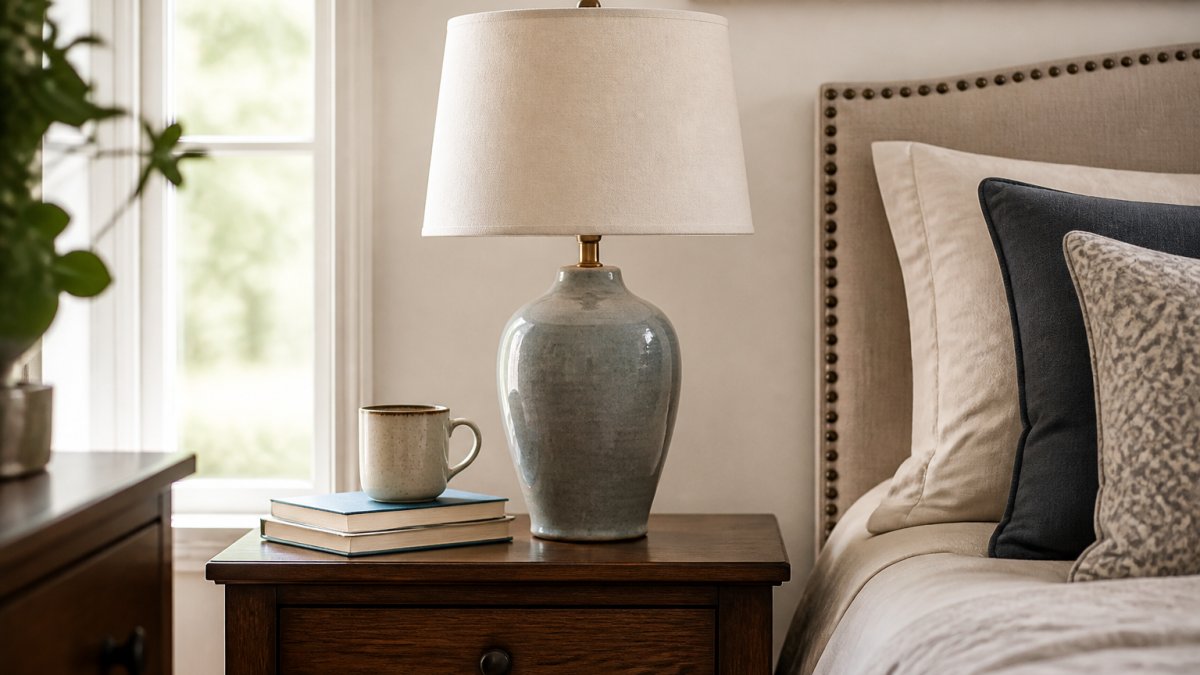
A common mistake is pushing the lamp all the way into the corner to free up surface area. That throws the light off-center and leaves a dark pocket on the side of the bed where you actually need it. Instead, measure the nightstand's depth and place the lamp's base center at roughly one-third of the depth from the back edge.
Cord Management and Usable Surface
Leave roughly half the table surface clear for the things you actually use at night: phone, glasses, water, a book. Route the cord down the back leg of the nightstand and secure it with a clip or a Velcro tie so it doesn't drape across the floor. If your nightstand sits against an outlet-free wall, a slim extension cord tucked behind the furniture keeps things tidy without visible cable spaghetti.
A simple layout rule: put the lamp at the back-center of the nightstand, the phone and charger at the back corner nearest the outlet, and the water glass and book at the front edge within easy reach. That keeps the cord run short and the front edge open. If you use a charging cable nightly, a small cable clip on the back edge of the nightstand stops it from sliding onto the floor.
Bedside Lamp Shade Size: Height, Width, and Shade-to-Base Ratio
Bedside lamp shade size should feel proportional to the base, with the shade's height roughly matching the base's height and its width comfortably wider than the widest part of the base.
Why does the shade-to-base ratio matter so much? A shade that's too narrow looks pinched and concentrates light into a tight beam. One that's too wide swallows the base visually and spills light across the whole room instead of onto your book. The shade's bottom edge should also fall at or slightly below eye level when you're seated, which ties back to the height rule above.
Fabric shades in linen or cotton soften light nicely for a bedroom. Downward-facing shades direct light where you need it for reading; upward-and-downward designs add a wash of ambient glow on the wall behind.
Matching Lamp Size to Nightstand and Headboard Proportions
Lamp size should relate to both the nightstand beneath it and the headboard behind it. A tall upholstered headboard can carry a larger, more sculptural lamp; a low platform bed calls for something shorter and visually lighter. The lamp's total height, base plus shade, should land somewhere between the nightstand surface and the top of the headboard so it doesn't get lost or compete.
Width matters too. On a narrow nightstand, choose a lamp with a narrow base and a shade that doesn't extend past the table's edges. On a generous nightstand, a wider ceramic or jug-style base balances the surface.
Bedroom Lighting Ideas: Layering Task and Ambient Light
Bedroom lighting works best in layers: a bedside task lamp for reading, softer ambient light for winding down, and a low-level glow so you're not walking into a dark room. The table lamp handles the first two jobs if you choose the right bulb and shade direction.
Consider adding a wall sconce or a pendant lamp above the nightstand if surface space is tight. A floor lamp in the corner adds ambient light without touching the nightstand at all. For renters, plug-in sconces and freestanding lamps deliver the layered look without permanent wiring, and they move with you when you go.
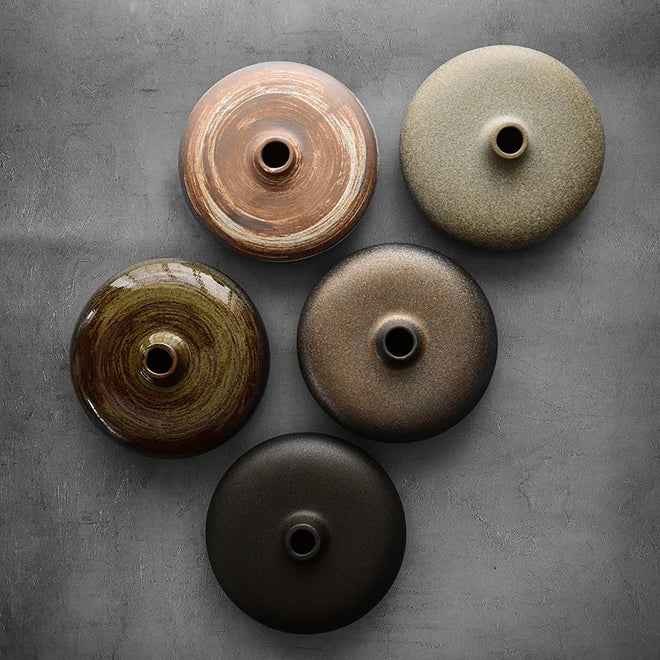
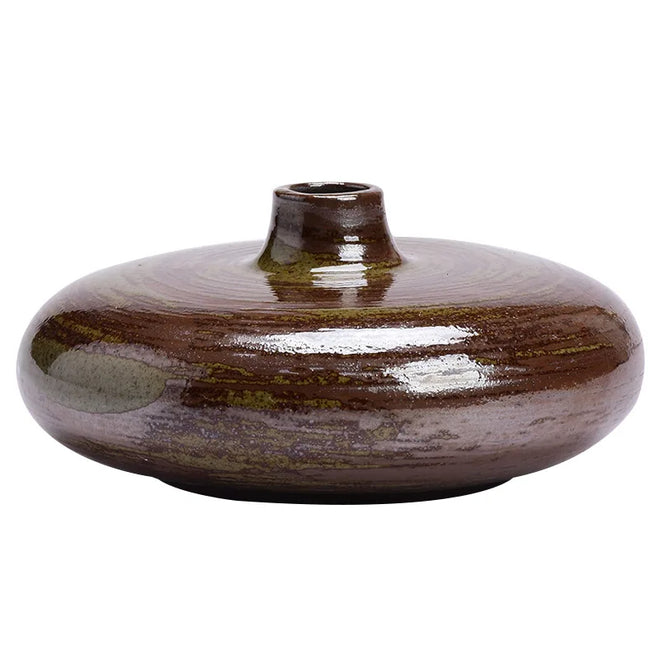
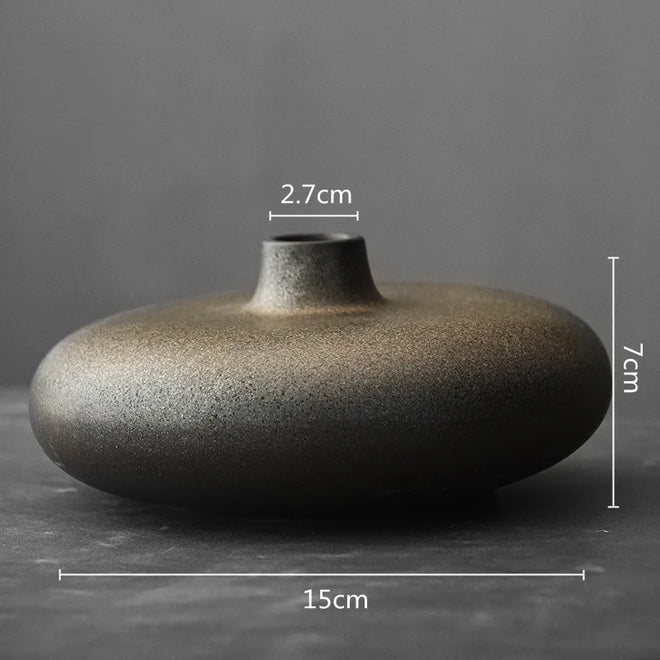
Round Rustic Wabi Sabi Ceramic Nordic Textured Table Lamp →
Bulb Brightness and Color Temperature for Reading and Winding Down
For reading, look for a bulb in the warm-to-neutral range, roughly 2700K to 3000K, bright enough to light the page without glare. A common target is 400 to 600 lumens directed at the page; anything much brighter in a small shade creates a hot spot.
Beam direction matters as much as brightness. A downward-facing shade concentrates light on your book and keeps the room dim, which is ideal for reading in bed without waking a partner. An upward-and-downward shade throws light onto the wall and ceiling for a softer ambient wash.
If your lamp isn't dimmable, a smart bulb or a plug-in dimmer is the simplest fix. Our Rustic Metal Ceramic Pottery Fabric Shade Table Lamp is dimmable and comes with a remote, which makes the task-to-ambient switch easy without getting out of bed.

Troubleshooting Common Table Lamp Placement Problems
The lamp is too short and the light hits your eyes. Raise the lamp on a stack of two hardcover books, or swap to a taller base.
The shade throws a harsh ring of light on the wall. The shade is too narrow or the bulb is too bright for the shade's size.
The nightstand feels crowded. Move the lamp back, clear the surface to half, and route cords behind the furniture. A compact lamp with a narrow base frees up space without sacrificing light.
The two nightstands look uneven. Check that both lamps sit at the same distance from the front edge and that the shades match in height. Symmetry is read instantly by the eye.
The lamp overhangs the table. The base is too wide or the shade too large for the surface. Size down rather than shifting it back, which only moves the problem.
Conclusion
Getting table lamp placement right comes down to a handful of measurements: seated eye level, shade-to-base ratio, and a clear half of the nightstand surface. Nail those and the rest is styling.
If you're refreshing a bedside corner, browse our curated lighting collection at The Finishing Touch Decor, LLC. Every piece ships free on orders over $50, and our mix of French Country, Coastal, Bohemian, and Nordic Scandi styles makes it easy to find a lamp that fits your room's proportions and your personal taste. View More and start with the measurement, then let the lamp do the rest.

Frequently Asked Questions
What height should a bedside table lamp be?
The bottom of the lampshade should sit at or just below your seated eye level, roughly 20 to 24 inches above the mattress top for most adults. Measure from the floor to the top of your mattress, then subtract the height of your nightstand to find the lamp height that lands the shade in that range. A lamp that is too short casts light upward into your eyes, while one that is too tall can feel overpowering next to the bed.
What is the 5'7" lighting rule?
The 5'7" lighting rule is a simple reference for hanging pendants and chandeliers so the bottom of the fixture sits around eye level for a person of that height, keeping the bulb out of direct view. It is a general guideline, not a fixed standard. For table lamp placement on a bedside table, the more useful version is to keep the shade bottom at your own seated eye level, which you can check by sitting on the bed and looking straight ahead.
Should bedside lamps be centered on the nightstand?
Centering the lamp works when the nightstand is wide enough to leave 2 to 3 inches of clear surface on each side of the base. On a small bedside table, shift the lamp slightly toward the back corner so the front stays open for a phone, glasses, or a book. Keep the lamp base at least 2 inches from the edge to reduce the chance of knocking it over, and check that the shade does not overlap the mattress.
How much space should be left around a bedside lamp?
Leave about 2 to 3 inches between the lamp base and the sides of the nightstand, and at least 2 inches from the front edge. The shade should clear the wall by a few inches so light can spill onto the surface below and the fabric does not scorch or discolor. If your nightstand is narrow, a compact lamp with a narrow base frees up more usable surface than a wide ceramic body.
Do bedside lamps need to match?
Matching lamps create a formal, symmetrical look that suits traditional and French Country bedrooms. For Coastal, Bohemian, or Nordic Scandi rooms, a pair that shares height and shade shape but differs in finish or texture reads as intentional rather than mismatched. The one rule worth keeping is equal shade height on both sides, so the light falls at the same level whether you read on the left or the right.
What bulb brightness and color temperature work best for reading in bed?
For reading, aim for a bulb around 400 to 800 lumens with a color temperature near 2700K to 3000K, which gives a warm white light that is easy on the eyes. Choose a lamp with a downward-facing fabric shade to direct light onto the page instead of into the room. For winding down, a dimmable option or a lower-lumen bulb lets you drop the light level without switching fixtures.
A bedside lamp that's measured, centered, and proportioned turns a functional corner into the calmest spot in your home. At The Finishing Touch Decor, LLC, we help you get there with curated lighting, free shipping on orders over $50, and a range of design styles from French Country to Nordic Scandi. Get started with The Finishing Touch Decor, LLC and build a bedside setup that looks as good as it feels.